


Synopsis: Although the Malaysian companies have a significant footprint in Cambodia, there is still ample room for expansion, particularly as both nations seek to diversify supply chains and promote sustainable commercial practices, says Shaharuddin Onn, Malaysian Ambassador to Cambodia.
Cambodia and Malaysia are poised to see their bilateral trade surpass the $1 billion mark this year, a milestone that underscores deepening economic ties and growing private-sector engagement between the two ASEAN nations.
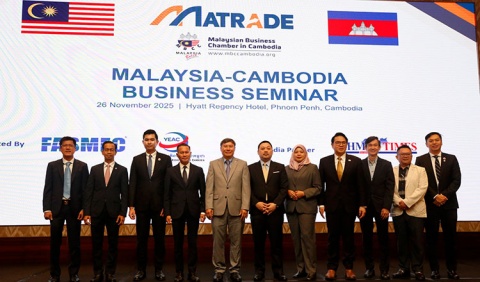
The outlook was shared by Sim Sokheng, Secretary of State at the Ministry of Commerce, during the Cambodia Business Seminar and Business Matching (B2B) event held at the Hyatt Regency Phnom Penh yesterday.
The seminar was organised by the Trade Office of the Consulate General of Malaysia (MATRADE), which brought together policymakers, business leaders and industry experts aiming to accelerate commercial cooperation.
Sokheng said the event plays a crucial role in strengthening partnerships that contribute to both nations’ business ecosystems.
He noted that Cambodia’s private sector is expected to be an engine of growth as the country progresses toward upper-middle-income status by 2030 and high-income status by 2050.
The senior government official emphasised that Malaysian firms were among the earliest investors in Cambodia after the early 1990s and have remained important contributors to the Kingdom’s development.
One of Cambodia’s most attractive features, he said, is the option of 100 percent foreign ownership, a policy that continues to draw sustained investment across industries.
Representing MATRADE, Mazlan Harun, Director of Export Promotion and Market Access, said the seminar was designed as a practical, results-driven platform that connects Cambodian importers with Malaysian exporters.
He highlighted Cambodia’s resilient global trade performance and the competitiveness of many local sectors that present collaboration opportunities for Malaysian companies.
The confidence in Cambodia’s broader economic potential, he added, supports long-term, mutually beneficial partnerships.
According to MATRADE data, bilateral trade between the two countries stood at $961.4 million in the January-October period of the current year, up 38.9 percent compared to the previous year.
Malaysian Ambassador to Cambodia Shaharuddin Onn lauded MATRADE’s trade mission and said the growing relationship is built on trust, mutual respect and a shared vision for regional prosperity.
He noted that the event unites key stakeholders — from business leaders to industry specialists — to unlock new opportunities in a rapidly changing global environment.
Malaysian companies already have a significant footprint in Cambodia, and the ambassador said there is ample room for expansion, particularly as both nations seek to diversify supply chains and promote sustainable commercial practices.
The high level of participation from Cambodian distributors, chambers of commerce and importers, he added, signals a strong appetite for closer cooperation.
Offering a broader perspective on Malaysia’s trade trajectory, Zaimah Osman, Trade Commissioner at MATRADE Ho Chi Minh City, said Malaysia maintains trade relations with more than 200 countries and currently ranks as the world’s 25th-largest exporter.
She detailed how the country’s trade volume grew from $3.07 billion in 1970 to $630 billion in 2024 as it transitioned from an agriculture-based economy to a manufacturing and later digital-driven one.
“In 2023, Malaysia held the position of the world’s largest exporter of 26 products, spanning 19 manufactured items and seven agricultural goods.”
Zaimah also underscored the importance of the Madani Digital Trade (MDT) platform, an AI-enabled national digital trade system designed to streamline and elevate Malaysian exports by supporting SMEs and connecting them with global buyers. Cambodian firms, she said, can use MDT to source products directly through the platform.
The event was also addressed by Thomas Leng, Undersecretary of State at Cambodia’s Ministry of Commerce, who commended Malaysia’s key role in the ceasefire agreement between Thailand and Cambodia and encouraged Malaysian businesses to take advantage of Cambodia’s strategic location, which provides access to a market of 600 million consumers across ASEAN.
He highlighted the country’s stable economic environment and its alignment with Malaysia’s economic philosophies. Leng also pointed to Cambodia’s extensive trade agreements, including the Regional Comprehensive Economic Partnership (RCEP), bilateral FTAs with China and South Korea, and the Comprehensive Economic Partnership Agreement with the UAE.
“These frameworks create fertile ground for investment in sectors such as agro-processing, halal products, renewable energy, textiles, manufacturing, electronics, logistics and warehousing,” he said.
Presentations during the seminar covered a range of topics, including a session by Tan Khee Meng, President of the Malaysian Business Chamber in Cambodia, who spoke on Cambodia’s investment climate and tax laws.
Sok Sovithyea, Deputy Director General of the General Department of Customs and Excise, discussed existing platforms designed to support dialogue between customs authorities and the private sector.
A panel discussion moderated by Tan added further insight into Cambodia’s evolving industries and its value proposition as an investment destination.
The B2B session concluded with participation from nine Malaysian companies across diverse sectors, signalling strong momentum for expanding commercial cooperation as the two nations move closer to crossing the $1 billion trade threshold.