


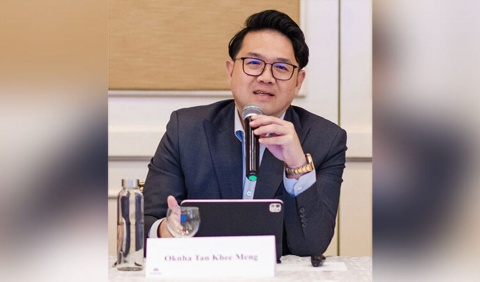
Synopsis: Following the Annual General Meeting of the Malaysian Business Chamber in Cambodia, which saw a major brand reinvention and digital infrastructure deployment, Khmer Times sits down with its President Oknha Tan Khee Meng to discuss the mechanics of this transformation and the future of Malaysia–Cambodia economic synergy.
The year 2026 marks a historic milestone for the Malaysian Business Chamber in Cambodia, reflecting on more than three decades of institutional presence. In an interview with Khmer Times, MBCC President Oknha Tan Khee Meng evaluates the core achievements of the business chamber over this extended period, and how its role has adapted to Cambodia’s macroeconomic shifts.
Oknha Tan Khee Meng: Thank you. It is a privilege to reflect on this extraordinary journey. Over the past 33 years, MBCC has evolved from a small, close-knit group of pioneering Malaysian investors into one of the most authoritative, structurally sound foreign business chambers in the Kingdom of Cambodia. Our legacy is inextricably linked with Cambodia’s post-conflict reconstruction and its subsequent rise as one of the fastest-growing economies in the ASEAN region.
Malaysian entities were among the earliest to demonstrate unshakeable confidence in the Kingdom’s economic potential. We entered the market when infrastructure was nascent, pioneering foundational sectors including commercial banking, telecommunications, infrastructure development, energy generation, textile manufacturing and hospitality. Our primary achievement has been our ability to act as a highly trusted, reliable partner to the government of Cambodia.

Our impact extends far beyond capital injection. Over the last three decades, Malaysian corporations have been key drivers of human capital localisation. We have prioritised the training, upskilling and advancement of Cambodian professionals, many of whom now occupy top-tier executive leadership seats across our institutions. From a diplomatic and civic perspective, MBCC has consistently championed high-impact corporate social responsibility initiatives, directly supporting the government’s humanitarian agendas.
Khmer Times: The AGM voted to adopt a brand-new corporate logo and image. Could you dissect the message underpinning this refresh?
Oknha Tan: Branding is never merely cosmetic; it is a visual declaration of strategic intent and corporate health. Our previous identity served us exceptionally well during our foundational decades, but our corporate ecosystem has expanded in scope, sophistication and digital integration.
The new logo is a calculated harmonisation of our historic values and our forward-looking mandate. It is anchored by flowing, curved lines that represent dynamic agility, resilience and a multi-stakeholder culture of collaboration. In a modern economy, business chambers cannot afford to be rigid bureaucratic institutions; we must move with the speed of global markets.
The three upward-soaring arrows represent progression, corporate ambition and our growth trajectories
Khmer Times: The launch of the native MBCC mobile app was a centrepiece of the 2026 AGM. How does this platform modernise communication for your members, and what long-term operational objectives does it satisfy in this high-tech era?
Oknha Tan: We live in an era where data immediacy and seamless digital connectivity are baseline prerequisites for commercial competitiveness. The MBCC app represents a paradigm shift in how a modern business chamber communicates with its constituents and the general public.
Historically, business chamber communications relied on traditional channels—periodic emails, physical circulars and scheduled mixers. The new application eliminates these logistical frictions by creating a unified, secure digital ecosystem accessible instantly from any mobile device.
For our corporate members, the platform is a catalyst for business-to-business interaction. The interactive Member Business Directory allows investors to source trusted local partners, verify corporate credentials and initiate secure cross-border dialogues. The real-time newsfeed delivers critical market intelligence, breaking regulatory announcements and macroeconomic updates to our members. This is vital for risk mitigation and strategic planning.
Features such as automated event registration, management of exclusive member privileges and analytical survey tools allow the MBCC Board to gather direct, empirical feedback from our members. This ensures that our advocacy efforts before the government are backed by real-time data.
Khmer Times: The Board of Directors has expanded with two new committee members while Mr T Mohan has been appointed senior adviser. What is the strategy behind these leadership appointments?
Oknha Tan: Institutional longevity requires continuous governance renewal. As the volume of trade between Malaysia and Cambodia scales up, the demands placed upon our leadership bench naturally increase. The addition of two committee members into our Board broadens our sectoral oversight, introducing fresh corporate expertise from emerging industries to enrich our decision-making matrices.
The appointment of Mr Mohan as senior adviser is an exceptionally strategic decision. Mr Mohan is a highly respected figure possessing an uncommonly profound understanding of the Cambodian media landscape, public relations vectors and institutional communications. His structural insights will be invaluable as MBCC amplifies its public advocacy footprint.
In a complex regulatory environment, clear, transparent and sophisticated communication with all stakeholders—including our members, our host government and foreign investors—is paramount. Mr Mohan will provide the executive board with high-level advisory oversight, ensuring our public positions and member services are articulated with precision and maximum impact.
Khmer Times: In your dual role as MBCC President and managing partner of Baker Tilly Cambodia, you possess a unique vantage point regarding fiscal discipline and corporate compliance. How do you see these elements influencing the future of foreign investments in the Kingdom?
Oknha Tan: The late 2020s landscape demands absolute transparency, fiscal rectitude and strict adherence to international accounting and tax standards. Cambodia has made monumental strides in modernising its tax administration, security frameworks and accounting compliance under bodies like the General Department of Taxation, the Accounting and Auditing Regulator, and the Securities and Exchange Regulator of Cambodia.
At Baker Tilly, we counsel clients that long-term profitability is impossible without strict compliance. At MBCC, we mirror this philosophy. We guide our members to implement robust corporate governance, transparent financial reporting and systematic compliance structures.
By building an ecosystem of highly compliant, audit-ready enterprises, we enhance Cambodia’s reputation as a premium investment destination. It creates a virtuous cycle: when international investors see that Malaysian businesses operate with the highest levels of transparency and fiscal discipline in Cambodia, it reduces the perceived risk premium and attracts institutional, high-value global capital.
Khmer Times: What are the primary sectors and strategic objectives that MBCC will prioritise to deepen the synergies between Malaysia and Cambodia?
Oknha Tan: Our forward-looking strategy is aligned with the government’s vision, particularly the structural frameworks outlined in the Pentagonal Strategy. We are steering Malaysian investment away from purely traditional sectors and guiding it towards high-growth, high-value-added industries.
First, we are focusing on green energy and sustainable infrastructure. Malaysian companies have extensive regional experience in solar power deployment, biomass energy and sustainable construction, which can accelerate Cambodia’s carbon-neutrality targets. Second, we are driving partnerships in advanced agriculture and agro-processing, helping Cambodia move up the global agricultural value chain. Third, digital infrastructure and fintech remain a high priority, where we can leverage our tech expertise to support Cambodia’s digital economy transition.
Underlying these initiatives is a commitment to Environmental, Social and Governance criteria. We will prove that economic synergy between our two nations is not just about financial returns, but about building an inclusive, technologically advanced and socially responsible future for the peoples of Malaysia and Cambodia.