


Synopsis: The overarching message from Cambodia’s leadership is clear: amid global uncertainty, deeper regional cooperation, structural reforms, and decisive governance measures—such as the eradication of online scams—are essential to securing sustainable growth and investor confidence in the years ahead.
Cambodia is intensifying efforts to position itself as one of Southeast Asia’s most attractive investment destinations, with Prime Minister Hun Manet pledging to eradicate online scam operations by April as part of a broader strategy to strengthen the country’s business climate.
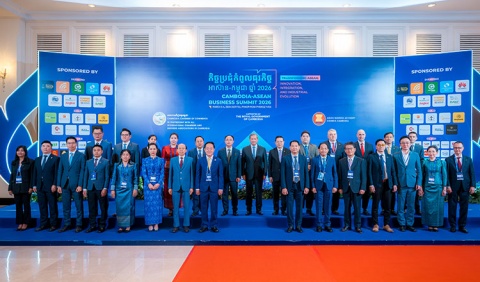
Speaking at the Cambodia-ASEAN Business Summit 2026 (CABS 2026) in Phnom Penh, the Prime Minister told regional leaders and global investors that the government’s shift from containing online scams to completely eliminating them underscores its commitment to safeguarding the integrity of Cambodia’s investment environment.
The summit, held under the theme “Transforming ASEAN: Innovation, Integration and Industrial Evolution,” brought together senior government officials, diplomats, and business executives from across Southeast Asia and beyond. Among the prominent participants were Kith Meng, President of the Cambodia Chamber of Commerce and Chair of ASEAN-BAC Cambodia; Kao Kim Hourn, Secretary-General of the Association of Southeast Asian Nations; Anthony Patrick Chua, Representative of the ASEAN Business Advisory Council 2026 Chair from the Philippines; and Sun Chanthol, Deputy Prime Minister and First Vice-Chairman of the Council for the Development of Cambodia.
In his opening address, Mr Hun Manet stressed that the gathering was not merely a forum to observe current market trends but a strategic platform to seize opportunities arising from profound shifts in the global economy.

“This summit is about delivering concrete outcomes,” he said, expressing confidence that the event would generate valuable business partnerships, facilitate productive business-to-business meetings, and deepen trust between governments and the private sector across ASEAN.
The Prime Minister’s remarks came against the backdrop of mounting global uncertainty. He noted that as ASEAN advances toward the ASEAN Community Vision 2045, member states must confront a dramatically altered economic landscape shaped by climate change, supply chain disruptions, and escalating geopolitical tensions, particularly conflicts in the Middle East.
“These developments demand stronger regional resilience,” Mr Hun Manet said, calling for deeper economic integration, diversification of energy sources, and enhanced coordination mechanisms to respond effectively to crises.
Amid these global headwinds, Cambodia is promoting what the Prime Minister described as a stable and predictable investment climate anchored in political stability and macroeconomic resilience. He highlighted the country’s broad market access, forward-looking legal framework, and ongoing reform agenda as key advantages for international investors.
“Cambodia offers highly attractive strategic advantages for global investors,” he said. “We have established a secure and predictable environment to minimise policy risks, build investor confidence, and ensure long-term business sustainability.”
A central pillar of that effort is the government’s crackdown on online scam centres, which have drawn international scrutiny in recent years. Mr Hun Manet emphasised that the Royal Government has moved decisively from a containment approach to a policy of total eradication, with a firm deadline set for April 2026.
The campaign, he said, will involve strengthened law enforcement, stricter institutional compliance, and coordinated action across ministries to protect Cambodia’s reputation as a safe destination for investment.
To further enhance the business climate, the government has established an inter-ministerial task force comprising more than 100 members from 30 ministries and institutions. The task force has developed the Cambodia Business and Investment Environment Improvement Program 2025–2028, officially approved in November 2025. The programme aims to streamline procedures, reduce administrative burdens, and modernise regulatory frameworks in line with international best practices.
At the regional level, Mr Hun Manet reaffirmed Cambodia’s commitment as an active ASEAN partner. He noted that the country recorded economic growth of 5.2 percent in 2025 and is projected to maintain robust medium-term growth, creating expanding opportunities across manufacturing, services, digital industries, and infrastructure.
Cambodia’s liberal investment regime remains a cornerstone of its appeal. The Royal Government permits 100 percent foreign ownership in nearly all sectors, without mandatory local shareholding requirements. Investors can also benefit from tax incentives of up to nine years, providing long-term clarity and predictability.
Recognising the importance of infrastructure to economic efficiency, Mr Hun Manet highlighted ongoing investments in logistics and connectivity. He pointed to the development of the Funan Techo Canal as a transformative project that will grant Cambodian exports direct sea access, reducing reliance on transit through third countries and lowering transportation costs.
“I urge all leaders in this room to look beyond the immediate horizon,” he said. “Let us work together to build the infrastructure for a brighter future.”
In his remarks, Kith Meng underscored ASEAN’s rising global prominence. By 2030, he said, the bloc is projected to become the world’s fourth-largest economy, with a combined gross domestic product approaching $10 trillion.
“This transformation will not occur by chance,” he said. “It will be the result of deliberate policy choices, regional cooperation, and sustained private sector engagement.”
Meng noted that CABS 2026 builds on Cambodia’s experience hosting ASEAN Summits in 2002, 2012, and 2022, but emphasised that the focus now is firmly on the future.
A major milestone this year, he said, was the signing of the ASEAN Digital Economy Framework Agreement (DEFA), described as the world’s first region-wide digital agreement. The framework is expected to double ASEAN’s digital economy to $2 trillion by 2030, accelerating cross-border e-commerce, digital payments, and innovation-driven growth.
Meng added that Cambodia has embraced a model of strategic openness, positioning itself as an emerging digital and industrial hub within the region. With projected growth of around five percent in 2026, he said the country’s expansion reflects not only post-pandemic recovery but also a structural shift toward higher-value activities and greater resilience.
Guided by Vision 2050, Cambodia is committed to achieving high-income status through sustainability, innovation, and deeper regional integration, he added, urging chief executives and investors to use the summit as a platform to forge concrete partnerships.
During a networking cocktail event held on Tuesday evening, Minister of Commerce Cham Nimul echoed the summit’s central theme. She described “Transforming ASEAN: Innovation, Integration, and Industrial Evolution” as a reflection of the collective ambition embodied in ASEAN Community Vision 2045.
Cham Nimul highlighted significant untapped investment potential within ASEAN and called on the region’s private sector to strengthen business linkages and investment networks to advance economic integration.
To support these objectives, she noted, ASEAN continues to reinforce its institutional and policy frameworks, including amendments to key agreements such as the ASEAN Trade in Goods Agreement and the ASEAN Comprehensive Investment Agreement. These reforms aim to make regional trade and investment rules more robust, transparent, and effective.
At CABS 2026, the overarching message from Cambodia’s leadership was clear: amid global uncertainty, deeper regional cooperation, structural reforms, and decisive governance measures — such as the eradication of online scams— are essential to securing sustainable growth and investor confidence in the years ahead.